
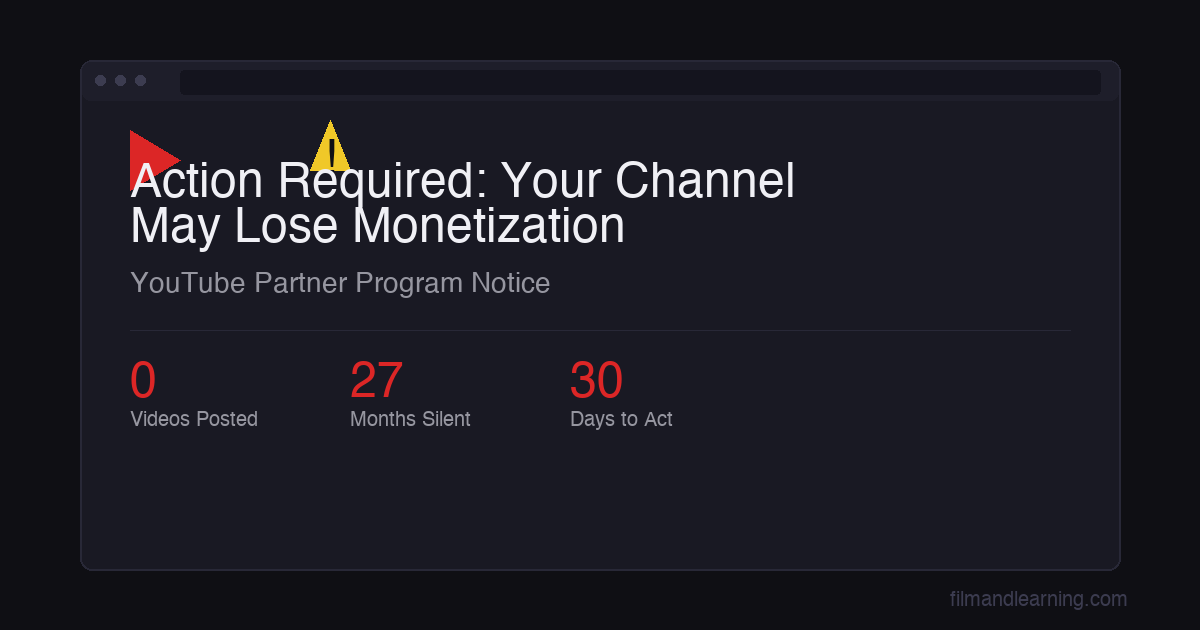
To prevent YouTube demonetization, you need to upload at least once every twelve months. I knew that rule. I still let the clock run out. The email landed on Tuesday, March 11, at 9:47 AM with a subject line that made my stomach drop: “Action required: Your YouTube channel may lose monetization.” I had uploaded zero public videos in twenty-seven months.
Twenty-seven months. That number sat on my screen while I stared through it. The shame was immediate and familiar, the kind that settles in your chest and makes you close the laptop instead of fixing the problem. I had a hard drive full of footage, a warning from YouTube, and thirty days to save my channel.
The Real Reason I Stopped Posting
The easy answer is burnout. The real answer is harder to admit: I was afraid the videos were not good enough, and I had no idea how to prove myself wrong. I had shot over twenty interviews and tutorials, building a library I was genuinely excited about. None of them made it past the rough cut because I kept telling myself the next editing session would be the one where everything clicked.
That moment never came. The footage sat on a 4TB drive gathering metadata and guilt. Every time I opened DaVinci Resolve, I saw the same project thumbnails and closed them.
I told myself I was planning, rewatching clips and researching LUTs I did not need. I was reorganizing bins that did not matter. I was avoiding the Export button because hitting it meant the video would be real, and real videos can fail.
This is the part of creator burnout nobody warns you about. It is not that you run out of ideas. It is that you stop trusting yourself to finish them. The longer you wait, the louder the voice gets that says you have lost the ability entirely.
Three Lies That Kept Me Stuck
I spent two years believing three things that were all false. Naming them here is uncomfortable, but that is the point. If you are sitting on a folder of unfinished videos, you are probably telling yourself the same stories.
The first lie was perfectionism dressed up as preparation. I told myself the first video back had to be my best work ever. It had to justify two years of silence in one upload. That is an impossible standard, and I knew it, but I let it paralyze me anyway because it gave me permission to keep waiting.
The second lie was that editing takes longer than I have. I kept imagining eight-hour sessions that would swallow entire weekends. I was not accounting for the fact that a thirty-minute rough cut on a simple talking head video takes about ninety minutes, not eight hours. My fear was building the task into something it was not.
The third lie was the volume trap. I convinced myself I had to release all twenty videos in a grand schedule, a proper comeback instead of a single upload. A one-video return felt small and embarrassing, so I released nothing for over two years. The grand schedule never happened, and the single video I could have posted in week one was still sitting unexported on month twenty-seven.
The Thirty-Day Plan That Broke the Cycle
When YouTube sends the monetization warning, you get thirty days to post one public video. That deadline became the best thing that happened to my workflow because it removed the choice. I could not wait anymore. The decision was made for me.
I opened the hard drive and picked the shortest, simplest project: a three-minute talking head piece about lighting a desk scene with one practical lamp. I had shot it on a single afternoon with one camera angle, no b-roll, and a window for fill light. It was not my best work. That was exactly why I picked it.
The goal was not to impress anyone. It was to finish. I stopped rewatching the raw footage, picked the best single take, committed to it, and cut the timeline in one pass. I had already written about talking head setups for other creators, but I had never applied that same approach to my own work and that irony was not lost on me.
Then I blocked two specific editing sessions on my calendar: Wednesday at 7 PM and Thursday at 7 PM. No phone, no browser tabs, no “let me check one reference” detours. Just the timeline and a countdown timer. When the timer went off, I stopped, even if the cut was not perfect.
The export took twelve minutes. I watched the progress bar like it was the final scene of a feature film, even though it was three minutes about a desk lamp. On day twenty-eight of the thirty-day window, I uploaded the video. The demonetization threat lifted within a week, but the real win was not the monetization but the proof that I could still finish.
What Changed After the First Upload
The second video took half the time. The third took a weekend. I had not forgotten how to edit. I had just forgotten what finishing felt like, and that feeling is the only thing that kills procrastination at the root.
Motivation does not come before the work. It comes after you finish something and realize you still can. A finished export rewrites every story you have been telling yourself about being stuck. The barrier was never the timeline or the raw footage but the belief that I had lost the ability to complete a project.
That experience changed how I think about consistent YouTube posting. One upload breaks the spell. The second builds the habit. The third makes you wonder why you ever stopped.
Frequently Asked Questions
How long can you go without posting on YouTube before demonetization?
YouTube requires at least one upload every twelve months to keep monetization active. After the warning, you have thirty days to post a new public video. If you miss that window, ads stop running on your entire channel and you have to reapply to the YouTube Partner Program.
What happens when YouTube demonetizes your channel?
Your existing videos stay online, but ads stop running on them. You lose revenue from both old and new content. Once you upload a new video that follows the guidelines, you can reapply through YouTube Studio. Approval usually takes a few days to a few weeks.
Can you reapply for monetization after being removed?
Yes. Upload a new public video, verify it follows community guidelines, and reapply in YouTube Studio. I was approved again within seven days of uploading. There is no penalty beyond the revenue lost during the gap.
How do you motivate yourself to edit when you do not want to?
Pick the shortest unfinished video you have and set a timer for ninety minutes. Cut one clean version without transitions or color grading. Just lock the picture and export. The goal is a finished video, not a perfect one.
What is the minimum upload schedule to keep YouTube monetization?
One public upload every twelve months is the minimum to maintain monetization. For channel growth, one video every three to four weeks is enough to build momentum without burning out.
Should I delete old footage that is stressing me out?
Archive it instead. Move unfinished projects to an external drive or cloud folder where they are not staring at you every time you open your project panel. The goal is to clear mental space, not destroy work you might revisit later.
Open your project folder right now and find the video closest to done. Cut one clean version this week with no grading or sound design. Just lock the picture and hit Export. One finished video changes everything.
Until Next Time — Mark